Showing posts with label Asian. Show all posts

Sunday, 9 October 2016

Black Pepper Tofu


Very many years ago I acquired a tiny little recipe book (I think it may have been a Guardian or Observer giveaway) that had Ottolenghi’s black pepper tofu recipe in it (it can also be found in his book Plenty). It was granted a turned corner - the only time I ever turn corners in books is cookey books, though I am more likely to use those little strip post-its, elsewhere it is a crime against books and should be punished - but relegated to fairly near the bottom of a long list of ‘one day I will cook this’ recipes. Even when my friend Phil cooked and raved about it I didn’t get around to it.

So I don’t know what prompted me to cook it on this occasion. I wish I could remember.

I cut the chilli and black pepper quantities back from 4 & 2½ tbsp to 2 and 1½ respectively - we normally have no problem with spicy heat but everywhere I had seen people write this up on blogs etc they talked of how super fiery it was and as it wouldn’t be just me eating it thought I’d err on side of caution in the first instance. I also cut down the garlic & ginger slightly as well as the spring onions (all the ingredients are in large quantities!) and added some Sichuan peppercorns. Oh and of course I cut back on the the butter because 75g? That’s a hell of a lot of butter.

To be honest and in retrospect, I’m not sure that cutting ingredients and adapting is such a great idea with Ottolenghi recipes as generally speaking his ingredient quantities often seem excessive (and far out according to a lot of people for many of them but I quite like that) but by and large the recipes work despite any misgivings at the beginning.

But anyway this was still good. Very good. As it turned out I soon realised that I had been unusually & excessively timid with the spicing and we could have easily handled the original quantities of chilli and black pepper.


Black Pepper Tofu
serves 2


400g firm, fresh tofu, cut into 3cm x 2cm blocks
cornflour
vegetable oil
50g butter
150g shallots, peeled and thinly sliced
2 red chillies, deseeded and thinly sliced
4 garlic cloves, crushed
1 tbsp chopped ginger
1½ tbsp crushed black peppercorns
1 tsp Sichuan peppercorns, toasted & crushed
1½ tbsp sweet soy sauce
1½ tbsp light soy sauce
2 tsp dark soy sauce
½ tbsp sugar
6 small, thin spring onions, cut into segments 3cm long, plus some green parts shredded to serve


Toss the pieces of tofu in the cornflour, shaking off the excess. Pour in enough oil into a large frying pan so that it is at a depth of 0.5cm and heat. Fry the tofu in batches in the oil, turning as you go. Once they are golden all around, and have a thin crust, transfer to some kitchen towel on a plate.


Clean out the pan and add the butter. Once it has melted over a low-medium heat, add the shallots, chillies, garlic and ginger, and sauté for about 15 minutes, stirring occasionally, until totally softened.


Add the soy sauces and the sugar.


When the soy is thoroughly stirred in add the crushed peppercorns.


Warm the tofu in the sauce for a few minutes, then add the spring onion, stir through and let simmer for a few minutes to wilt the onions a little.


Serve hot with steamed rice and some of the shredded spring onion greens sprinkled over.


Read More »

Monday, 4 July 2016

Thai Red Salmon Curry


I had doubts about blogging this as it is fairly similar to the Panang fish curry I have previously posted but in the end decided that it was different enough to warrant it.

We had this on a Sunday evening when I was back from visiting mum and bf (as was) from dropping off the boy so I what I wanted was speed. To that end I used ginger & garlic pastes but of course you can just use a crushed garlic clove and an equivalent amount of grated ginger instead. Galangal & kaffir lime leaves are purely optional although they will lend a depth and complexity of flavour, and if can’t get Thai or Holy basil use some of the normal Italian stuff.

Curry pastes differ wildly in strength & heat so adjust accordingly. I used 2 tablespoons as I like it strong and spicy but do adjust according to taste. Mae Ploy is a particularly good brand to get if you can. The tubs are quite big but they last well in the fridge and most closely resemble, to my mind, what a pounded Thai curry paste would look like if you made it yourself. If you use Mae Ploy it will also matter less if you don’t have galangal, kaffir and thai basil as they are already so well flavoured.

We used salmon obviously but you could just as easily use a white fish such as cod or haddock or in fact quite easily use chicken instead of fish, although obviously it will require a longer cooking time. Similarly I have added sugar snaps, mushrooms and baby corn but you could add whatever veg you like really


Quick Thai Red Salmon Curry
serves 2


½ tbsp rapeseed oil
1 shallot, finely chopped
1 tsp garlic paste
1 tsp ginger paste
½ tsp galangal paste (optional)
1½ -2 tbsp Thai red curry paste
165ml coconut milk
150ml vegetable stock
½ lime, juiced
½ tbsp Thai fish sauce
½ tsp palm (or brown) sugar
75g sugar snap peas, sliced in half on the diagonal
100g baby corn, sliced lengthways
75g mushrooms, chopped
200g salmon fillets, cut into 2.5cm (1in) cubes
½ tsp Thai basil paste
½ tsp sliced kaffir lime leaves
small handful coriander leaves, roughly chopped


Heat the oil in a frying or sauté pan over a medium heat and add the shallots. Fry for 3–4 minutes until softened. Add the garlic, ginger & galangal pastes and fry for 30 seconds until fragrant.

Add the red curry paste and fry for a further minute or so, stirring to coat the shallots.


Pour in the coconut milk and vegetable stock and bring to a steady boil then turn down and simmer for 5 minutes.


Add the lime juice, fish sauce and palm sugar. Stir in the vegetables and simmer for 3 minutes.

Add in the fish pieces and simmer for 3–5 minutes until just cooked.


Stir through the basil and limes leaves, simmer for 1 more minutes then serve over rice in bowls, garnished with the coriander.


Read More »

Wednesday, 29 June 2016

Honey Soy Chicken


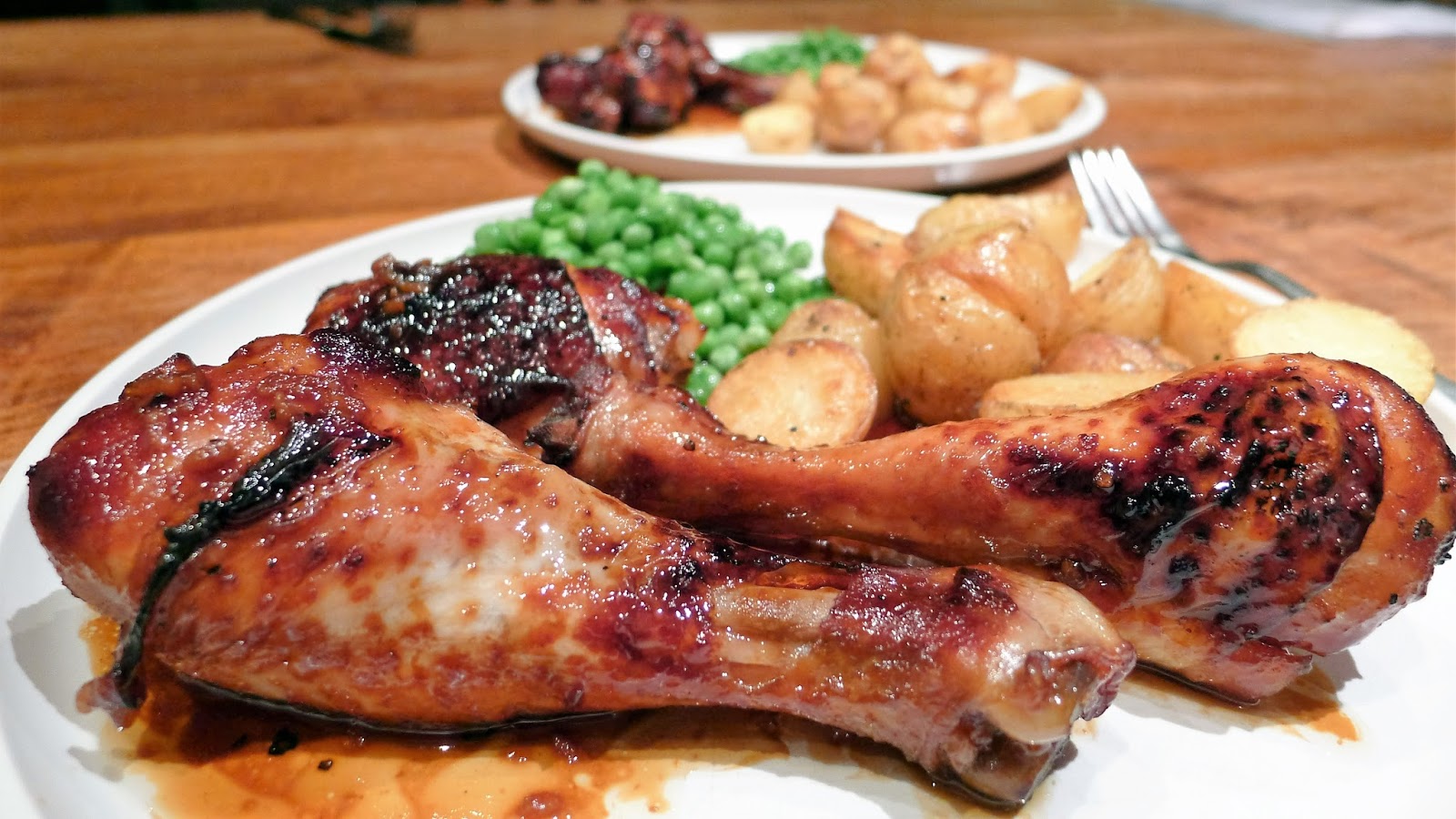
Marinating some chicken pieces in this honey & soy marinade means that you get not only beautifully tender and flavoursome dark meat falling off the bone but you’ll also end up with the most amazingly delicious sauce for drizzling over when you serve. Make sure then to serve this with something that you can soak up some of those tasty juices with. I opted for roasted baby potatoes but you could just as easily go for some crusty bread or mash.

It would have been nice to garnish with a little chopped parsley but sadly I forgot to buy some.


Honey Soy Baked Chicken
Serves 2


1 tbsp olive oil
½ tbsp toasted sesame oil
2 tbsp honey
2 tbsp light soy sauce
2 garlic cloves, crushed
¼ tsp ground ginger
¼ tsp freshly ground black pepper
4 bone-in chicken pieces with skin (I used 2 drumsticks and 2 thighs), about 500g
sea salt
parsley, chopped


Mix the first 7 ingredients together in a large plastic freezer bag and then the chicken pieces making sure to coat each piece in the marinade. Leave to marinade for a good couple of hours (or overnight in the fridge).

When ready to cook tip the chicken and marinade into a baking dish and bake in a preheated oven for 25 minutes with the thighs skin side up.


Turn the drumsticks and flip the thighs skin side down and cook for another 10 minutes. Then turn the drumsticks and flip the thighs again so they are skin side up again and finish cooking for another 10-15 minutes to crisp up the skin.


Make sure the chicken is cooked through and serve with some roasted baby potatoes and a green vegetable or salad.


Read More »

Friday, 24 June 2016

Cauliflower & Potato Curry


Of all the vegetarian dishes that I have cooked over the years, the one I have whipped up most frequently is probably this, or at least a variation of it. I say that as the recipe for this is actually quite fluid and I have probably never cooked it in exactly the same way twice. Potatoes and cauliflower are of course the mainstays but you can also add further veg as you see fit - often I add peas for instance and they are an excellent fit or you could add a larger mix: carrot, aubergine, peppers and so on.

Similarly make it as spicy or mild as takes your fancy: you could even add coconut milk if the mood takes you. Whatever you choose, serve with a big mound of fluffy basmati rice and if you can, the coriander yoghurt as it really lifts the flavours.

Note that you can peel the potatoes if you like, I don’t bother.


Cauliflower & Potato Curry
serves 2


1 tbsp vegetable oil
1 onion, finely chopped
2 cloves of garlic, crushed
2cm piece of ginger, finely chopped
½ tsp mustard seeds, toasted
½ tsp cumin seeds, toasted
small tin chopped tomatoes
3 curry leaves
½ tsp ground coriander
½ tsp ground cumin
½ tsp ground tumeric
¼ tsp cayenne pepper
300g potatoes, chopped into thick chunks
1 green chilli, deseeded (otional) and sliced
½ head cauliflower, cut into florets just larger than the potato
Greek-style yogurt
small handful coriander, chopped


Mix the chopped coriander with 3 or 4 tbsp yoghurt in a small bowl and set aside.


Mix the chopped coriander with 3 or 4 tbsp yoghurt in a small bowl and set aside.

Place the potatoes in a saucepan with salted water and bring to the boil. Boil a further 5 minutes, then drain.

Meanwhile heat the oil in a pan and add the onion, garlic and ginger. Cook for at least ten minutes until softened and golden.

Mix in the chilli and spices and cook for 2 minutes, constantly stirring.

Now add the potatoes and cauliflower, stirring to coat them in the spice mixture.


Add the tomatoes and curry leaves and simmer for 5 minutes.


Add about 250ml water, season generously then bring back to a simmer, cover and let cook for about 10 minutes.


Serve with some plain rice and the bowl of coriander spiked yoghurt on the side.


Read More »

Saturday, 11 June 2016

Taiwanese Meat & Mushroom Sauce with Rice


I’ve made a Taiwanese meat sauce before and in that recipe I mention that it can be made with chunks of pork, as that was, or with minced pork, as of course this is.

This is basically then a Chinese spaghetti bolognese, Taiwanese style and can be served over noodles, or as I have done here, rice.

I think that Taiwanese stewed pork is 滷肉, read as 'lu rou' in Mandarin and when boiled eggs are simmered in the sauce in this manner they are called 滷蛋 or 'lu dan'. How they come together as a name for the whole I’m not sure (and I have probably got it wrong anyway).


Taiwanese Meat & Mushroom Sauce
serves 1


100g minced pork
10g dried shitake mushroom, soaked and roughly chopped (keep the soaking water)
1 tsp dried shrimps (soaked and roughly chopped)
1 clove garlic, chopped
2 spring onions, chopped (reserve some green parts for garnish)
½ tsp five spice powder
2 tbsp sweet soy (I used kecap manis)
1 tsp light soy
½ tbsp Chinese black vinegar
1 small dried red chilli
1 tbsp Shaoxing wine
1 tsp sunflower oil
1 hard boiled egg, peeled
crispy fried shallot, to serve


Top up the reserved mushroom soaking water to 150ml and set aside.

Heat a wok and when hot add the oil and then the garlic and onion, stir fry for a couple of minutes till softened and lightly golden.

Add the dried shrimps and stir till fragrant and then add the pork mince, breaking it up into small pieces with the back of a wooden spoon. Keep stirring until the meat is almost cooked through and the wok is dry.

Add the wine and stir for a minute or so before adding the mushrooms and 5-spice. Keep stirring for another couple of minutes.


Add the soy sauces, vinegar and dried chilli.


Turn the heat up and add the diluted mushroom soaking water, bring to the boil and then turn down to a simmer and cook gently for at least 10-20 minutes (the longer the better as the pork will get more tender with increased cooking time). Stir occasionally and top up the water if necessary if it is getting too dry.

Add the egg.


Nestle the egg into the sauce for at least another 20-30 minutes, turning occasionally.


Serve the sauce over rice or noodles with the boiled egg halved and some spring onion greens and crispy shallots scattered over.


Read More »

Monday, 6 June 2016

Pork with Sichuan Chilli Oil Sauce


My 2nd recipe this week from the October 2014 issue of Olive magazine - moving from the Chettinad region of India to Chengdu in China and of course Sichuan cuisine: one of my favourites.

The recipes featured were taken from a cookbook called Hunan: A Lifetime of Secrets from Mr. Peng’s Kitchen. Confusingly the recipes therein are Sichuan in origin rather than Hunanese - the (co-)author, Mr Peng has a restaurant in Pimlico called Hunan, so-called it seems in homage to the man who taught him to cook, rather than the region.

Anyway, two recipes caught my eye - the first being for a Sichuan chilli “sauce” which to me resembled the chilli oil with sediment that I love to spoon over as much food as possible and then a dry pork dish, where the chilli sauce is used as a condiment.

The chilli sauce recipe makes quite a lot: which is fine by me as I poured the excess into a couple of little jars to keep and use as I like (edit: ahem - all now used up, which reminds me that I really must make some more), but you could possibly scale the ingredients down if you weren’t sure you would use as much as me. Be warned though it is FANTASTIC so if you do scale it down you may very well regret it.

You will also need to make some “garlic juice” for the pork marinade - simply crush 2 cloves of garlic and leave to steep in 100 ml of water for 20 minutes then strain and use the resultant allium scented water.

I was slightly disappointed by the pork but only in that mine didn’t look like the picture accompanying the recipe. I’m not sure why this was but I think it is down to one of 3 reasons (or a combination): I used quite a lot of oil in the frying but didn’t deep-fry as suggested; I didn’t dry the pork off as it came out of the marinade; I let it sit in the cornflour too long before frying. Don’t get me wrong, it was still delicious but didn’t have that hint of crispy batter that the pic showed.

But the sauce/oil more than made up that. Now to arrange a visit to the restaurant itself.


Sichuan Chilli Oil
Makes approx 300ml


4 tbsp dried red chilli flakes
200ml vegetable oil
2 tbsp Sichuan peppercorns, crushed
150ml chicken stock (you’ll use 6 tbsp + more possibly)
2 tsp tian mian jiang (sweet bean sauce or use hoisin)
2 tsp tomato purée
pinch of sugar
1 tsp white wine vinegar


Heat a wok and when it is very hot add one tablespoon of oil and the chilli flakes - be careful as there will probably be a lot of spitting and smoke. Not to mention sneezing.

As the chilli flakes absorb the oil add the rest of it, a tablespoon at a time until you have what resembles an oily paste. This will take 5-10 minutes.

The chilli flakes will darken considerably but be careful not to let it burn.

Take the wok off the heat and add the Sichuan peppercorns and 3 tablespoons of stock. Hold your nerve as it will sizzle and bubble up quite ferociously.


Stir through then put the wok back on the heat and add the sweet bean sauce, tomato purée, 3 more tablespoons of stock and a pinch each of salt and sugar.


Stir everything together well and add a bit more stock if you like but you need a thick yet runny sauce.


Finally add the white wine vinegar, stir through and remove from the heat. Reserve a couple of tablespoons to serve with the pork and carefully pour the rest (let it cool a bit) into a jar.


Pork with Sichuan Chilli Oil Sauce
serves 2


2 small boneless pork loin steaks, trimmed of fat, sliced into strips
100ml garlic juice (see note above)
2 tsp Shaoxing wine
2 tsp white wine vinegar
1 tsp Chinese 5-spice
2 tbsp cornflour
vegetable oil, for frying
1 long red chilli, finely sliced
2 cloves garlic, crushed
2 spring onions, sliced (the whole length, including greens)
a pinch of Sichuan peppercorns, crushed
2 tbsp Sichuan chilli sauce (as above)


Put the pork strips in a bowl with the garlic juice, Shaoxing wine, wine vinegar and 5-spice. Mix it all together well and set aside to marinate for 10 minutes.


Remove the pieces from the marinade and coat with the cornflour.

Heat a generous amount of oil in a wok and fry the pork until golden. When it is cooked, remove with a slotted spoon onto some kitchen paper on a plate.

Discard most of the oil and then quickly stir-fry the chilli, spring onion and garlic for a minute or so.


Return the pork to the wok and stir in the peppercorns and a pinch of salt.


Continue to stir-fry for another minute and then serve over plain rice with the Sichuan chilli oil sauce drizzled over.


Read More »